Packet and circuit switching.
Circuit switching is a connection that requires a dedicated circuit to be established before data can be transmitted. (use protocol UDP). Circuit switching is most commonly used to support telephone systems so that a conversation can be initiated whenever a user receives a call. Circuit switching provides the physical path between source and destination.

Advantages of using circuit switching
The sender and recipient addresses are only required at the stage of establishing a connection.
Guaranteed bandwidth for communicating subscribers.
Real-time traffic is transmitted without delay.
Ideal for voice communications (data packets are delivered in order).
Disadvantages of using circuit switching
The network may refuse to establish a connection.
Inappropriate use of bandwidth, which reduces overall network efficiency.
The dedicated circuit is not available for other services when the connection is in progress.
Packet switching is a data transmission model in which long messages are split into packets and sent to the recipient individually. (use protocol TCP). Example: Torrent.
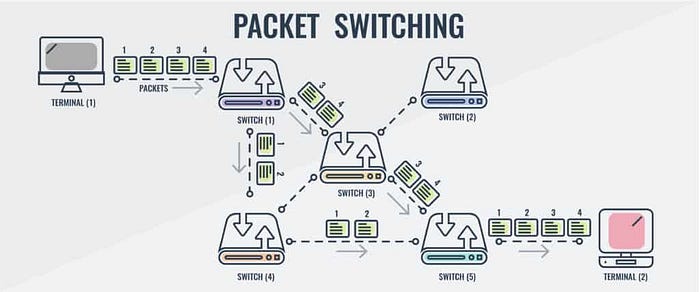
Advantages of using packet switching
A dedicated channel is not required, packets can find the addresses in different ways.
Reliability, because helps to avoid packet loss.
In packet switching, data packets can be resent if they do not reach their destination.
Ensures that packets reach their destination.
Disadvantages of using packet switching
Not suitable for low latency applications.
If there is too much traffic, packets can be lost along the way.
Packet switching depends on a number of complex protocols that need to be managed.