OSI (Open standart interconnection) Model.
OSI model
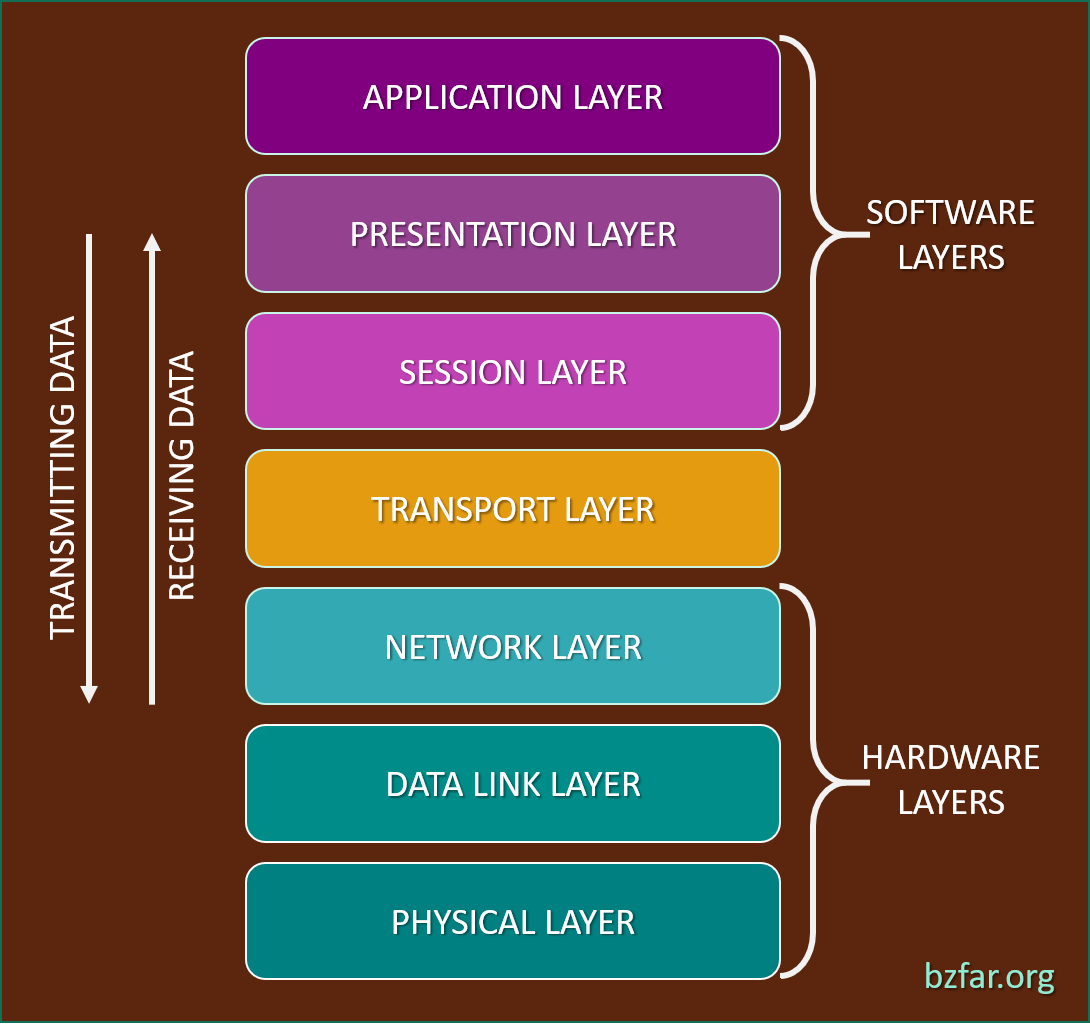
1. Physical Layer responsible for the physical connection between devices, for the transfer of individual bits from one node to another.
Key words: bits, cable, Ethernet, Wi-Fi, Bluetooth, hub
Physical layer functions:
Data rate control.
Defines the network topology (bus, star, etc.).
Defines the data transmission mode (simplex, half duplex and full duplex).
2. Data Link Layer is responsible for delivering a message from node to node.
Key words: frame, MAC address, switch
To deliver packets, the physical address of the device on the network is used - MAC address.
Data Link layer functions:
Framing allows the sender to transmit a set of bits that are meaningful to the receiver. This can be achieved by attaching special bit patterns to the start and end of the frame.
Physical addressing is performed by containing in the header of each frame the physical address (MAC address) of the sender and recipient.
An error control mechanism that detects and retransmits corrupted or lost frames.
3. Network Layer transfer data from one host to another located on different networks, takes care of packet routing, i.e. about choosing the shortest path for transmitting a packet from among the available routes.
Key words: packet, IP address, router
A segment of the network layer is called a packet.
The network layer is implemented by network devices such as routers.
Network layer functions:
Routing determines which route is suitable from source to destination using network layer protocols.
Logical addressing identifies each device on the internetwork with an IP address. This address makes each device unique and versatile.
4. Transport Layer receives data from the upper layers, performs segmentation, and controls flow and errors to ensure correct data transfer.
Key words: segment, TCP, UDP, port
The data in the transport layer are called segments.
The functions of the transport layer are :
Segmentation: This layer accepts the message from the (session) layer, breaks the message into smaller units. Each of the segments produced has a header associated with it. The transport layer at the destination station reassembles the message.
Service Point Addressing: In order to deliver the message to the correct process, the transport layer header includes a type of address called service point address or port address. Thus by specifying this address, the transport layer makes sure that the message is delivered to the correct process.
5. Session Layer responsible for establishing a connection, maintaining sessions, authenticating, and also providing security.
Key words: data, session, authentication
Session layer functions:
Session establishment, maintenance and termination: The layer allows two processes to establish, use and terminate a connection.
Dialogue controller: The session layer allows two systems to initiate communication with each other in half-duplex or full-duplex mode.
6. Presentation Layer data is retrieved from the application layer and processed according to the required format for transmission over the network.
Key words: data, translation, encryption, types of files (mp3, avi, docx, jpg, etc.)
Presentation layer functions:
Translation: for example, from ASCII to EBCDIC.
Encryption / Decryption
Compression: Reduces the number of bits that need to be transmitted over the network.
7. Application Layer produces data that needs to be transmitted over the network. This layer also serves as the interface between the user and services to access the network.
Key words: data, applications (browser, Skype, etc.), DNS, HTTP, POP, SMTP
Example: Application - What's Up, Browsers, Skype Messenger, etc.
Application layers functions are:
provides the end user with software such as web browsers, email clients, and others.
It provides protocols that allow software to send and receive information and present meaningful data to users.
uses HTTP/ FTP/ POP/ SMTP/ DNS protocols
provides various email services

Benefits of using
the OSI model:
It will help you standardize your router, switch, motherboard, and other hardware.
Reduces complexity and standardizes interfaces
Helps ensure technology interoperability, accelerates evolution
Protocols can be replaced with new protocols as technology changes.
This is the standard model in computer networks.
Offers flexibility to adapt to different types of protocols.
Drawbacks of using the OSI model:
It takes time to configure the protocols.
You can only use it as a reference model.
Does not define any specific protocol.
In the OSI network layer model, some services are duplicated at many layers, such as the transport and data link layers.
Layers cannot work in parallel, since each layer must wait for data to be received from the previous layer.